
Learning Through Experience

Updated: Apr 24

A Living Model for a Different Kind of Education for Children & Adults
There is a growing gap between how people naturally learn and how education is commonly structured.
The system that created these old educational structures, with the aim of producing consumers and workers who serve it, is collapsing. Schools and educational institutions can no longer hold this narrative.
We can already see that it is leading into a dead end.
Much of education today is based on separation:
Separation between subjects, between ages, between thinking and doing,
Separation between learning and life itself.
Knowledge is treated as something to receive, to memorize mechanically, and to reproduce.
Competition is part of this system. It serves a structure based on comparison and separation. It suppresses imagination, innovation, talents, skills, and lived experience.
Children are shaped to become future workers or obedient participants who must survive within the system.
Children are cut off from their own inner knowing from the moment they enter school.
They are told to obey, to ask for permission, to fit into predefined structures.
They are not taught ethos, morality, offering, co-creation, critical thinking and how to manifest their talents into a prosperous and joyful life.
Fear becomes part of learning.
And when this pressure becomes too much, children either withdraw, rebel, or become aggressive, all expressions of a system that does not meet them.
Learning does not begin this way
The key is not suppression to learn what they give you by force. The key is understanding and the activation of curiosity.
It begins with curiosity.
With imagination and inspiration.
With movement.
With contact, interaction and collaboration.
With the impulse to explore and to relate.
Learning Does Not Need to Be Forced
We invite a return to the senses, seeing, hearing, tasting, touching, smelling, and feeling, as a way of experiencing the world directly.
Through this, a natural sense of presence and responsibility can emerge, where engagement replaces disconnection, and participation replaces passivity.
When people enter an environment that allows participation, something changes.
They begin to engage.
They take on roles.
They respond to situations.
They interact with others.
Not because they are instructed to do so, but because the situation calls for it.
In such environments:
Curiosity is not created, it is already there.
Attention is not demanded, it emerges.
Responsibility is not assigned, it is taken.
Learning happens as a result of involvement and game.
Not as a task, but as a process.
Beyond Competition and Comparison
A central pattern in current education is competition.
Evaluation, comparison, and performance shape how people relate to learning — and to each other.
What we are proposing with the Luminous School of Creation is a shift away from this structure.
In collaborative environments:
there is no need to win
there is no advantage in being better than others
there is space for different abilities to appear
People begin to work together — even across groups.
The focus moves from outcome to process.
From comparison to participation.
To a
Play as a Ground for Learning
Play is often seen as something separate from learning.
But in reality, play is one of the most direct ways in which learning takes place.
Through play:
people explore without fixed outcomes
they test possibilities
they engage with uncertainty
they remain open and responsive
This creates a condition in which learning is not imposed, but unfolds.
Not through repetition, but through experience.
Learning (through experience) in Real Environments
Another key aspect is the environment itself.
Learning that is disconnected from life remains abstract.
When learning takes place in real environments — in landscapes, in communities, in shared spaces — it becomes grounded.
People relate to:
places
people
situations
processes
that are not predefined
This allows for a different kind of understanding.
Not only knowing about something,
but being in relation with it.
Memory, Culture and Living Connection
Through the experiences we are developing — such as the treasure hunts — people are invited to reconnect with something that is often forgotten.
Memory.
Not memory as stored information, but as a living connection.
Participants move through landscapes shaped by time.
They encounter traditions, local people, and ways of living that are still present.
They come into contact with:
the culture of the land,
the different people who live there,
the powerful Cretan nature,
the traditions and skills that once thrived in collaboration.
These were not created through competition, power, or greed,
but through cooperation, necessity, and shared life.
Through this, a different form of learning becomes possible.
A remembering.
A reconnecting.
A direct experience of how humans can relate, create, and live together.
No Separation Between Ages
The division between children and adults in education is often stronger than necessary.
The fundamental capacities for learning are shared:
curiosity
perception
imagination
the ability to relate
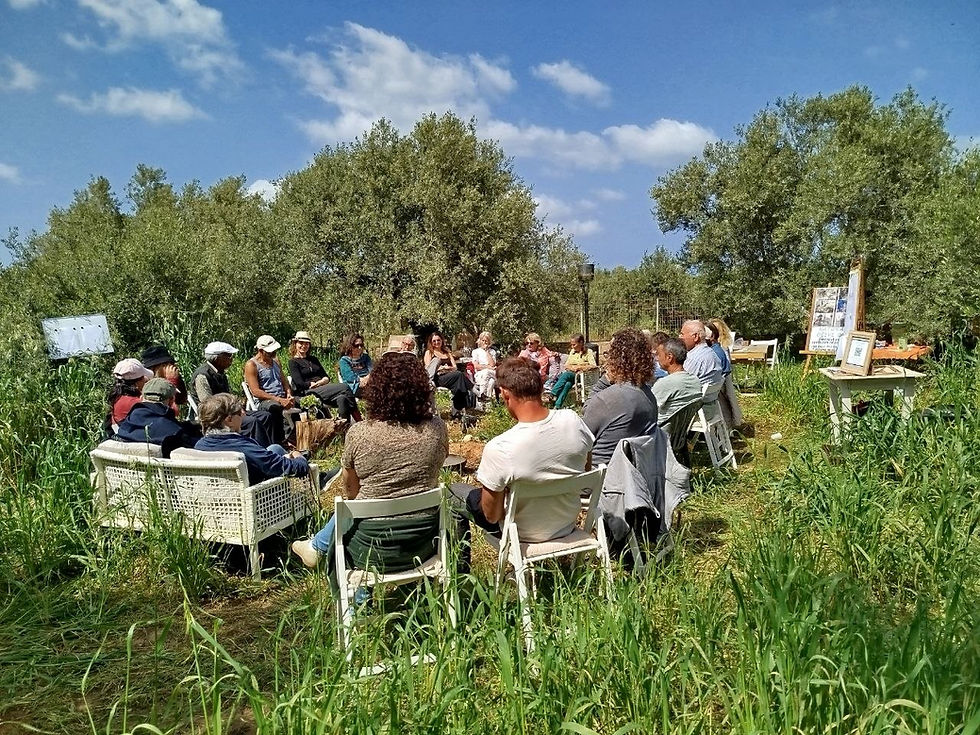
When supported, children and adults can participate in the same environments.
Not in identical ways, but in complementary ones.
Children can play.
Adults can rediscover play.
Teachers become facilitators instead of authority and part of hierarchy.
Learning becomes something shared.
Education as the Unfolding of Potential
Instead of shaping individuals into predefined forms,
education can support the unfolding of what is already present.
This includes:
talents not yet visible
sensitivities not yet recognized
ways of thinking and relating outside standard models
These cannot be forced.
They require space, interaction, and time.
They emerge in relationships — with others, with environments, and with real situations.
A Humanitarian Perspective
This approach to education is not only a concept.
It carries a humanitarian intention.
Access to meaningful learning environments should not depend on financial means.
While experiences today may be offered as paid activities,
the intention is to open this work further:
to make it accessible for children,
to offer it at low cost where possible,
or to create structures where it can exist independently of money.
This includes seeking support, funding, and alternative ways of sustaining such environments.
A Living Proposal
What is being proposed is not a fixed system.
It is an orientation.
A shift from:
instruction → participation
competition → collaboration
abstraction → experience
separation → connection
It does not require replacing everything.
It begins with creating spaces where this way of learning can take place.
Through simple elements:
a shared activity,
a real environment,
a situation that invites engagement,
and the freedom to respond.
From there, learning unfolds.
Learning through experience.
Not as something imposed from outside,
but as something that arises from within the process and the human being itself.
Shine Bright!
Sotiris Zafeiris
Luminous School of Creation


Comments